From Custom FPGA–DSP Hardware to Neural-Network Acceleration
Neural networks co-designed for custom FPGA–DSP hardware — built on the full software stack our engineers delivered for it.
Executive summary
Custom accelerator hardware was unusable without its software stack.
Kernel driver, RTOS port, interrupt handling and a full debugger.
Hardware-aware architecture search, mixed-precision quantization and real-time signal classification.
Programmable acceleration from day one, and AI models designed to fit the silicon.
System architecture
- L201
Host system
- L002
PCI bridge
- L003
FPGA + DSP
- L104
RTOS & ISRs
- L105
Kernel driver
- L306
Quantized NN runtime
- L207
Debugger & API
The challenge
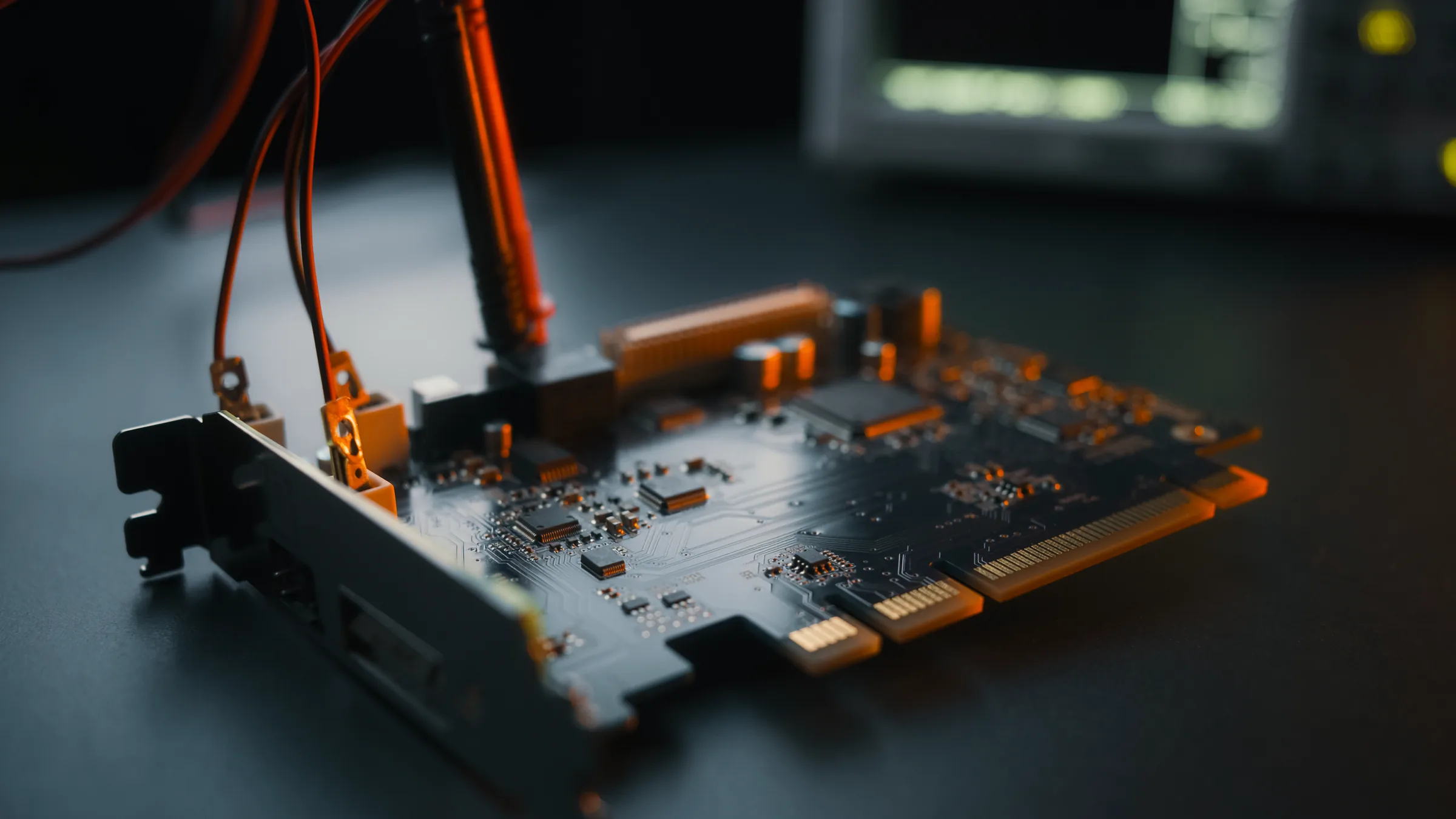
A custom PCI accelerator combined a DSP, an FPGA, a microcontroller and memory on one board. The hardware was capable, but without software to load, control and debug it, developers could not build on it — the product's value was locked behind a missing toolchain.
The foundation we built
A small engineering team delivered the whole stack: a kernel-mode driver and interface library for the host, the port of a real-time operating system to the DSP, interrupt-service routines, and a debugger with register inspection, single-step execution and call-stack views.
The AI layer
Ingot uses the same stack to run neural networks on FPGA and DSP fabric. Hardware-aware neural architecture search designs models that fit the device's DSP blocks and on-chip memory; mixed-precision quantization (INT8 and INT4) with accuracy-recovery training keeps results close to full precision. Typical workloads are real-time radar, vibration or image classification at the edge. LLM-assisted HLS and RTL generation, checked against golden vectors, shortens each hardware iteration.
What the customer gains
Custom hardware that developers can program and debug immediately — and AI models co-designed with the silicon for more performance per watt. It is the foundation for Ingot Silicon's FPGA inference and custom accelerator programs.
Foundation delivered
- Kernel driver and interface library
- RTOS port to the DSP
- DSP interrupt handling
- Board debugger application
AI Ingot delivers on it
- Hardware-aware neural architecture search
- INT8 / INT4 quantization with accuracy recovery
- Real-time radar, vibration and image classification
- LLM-assisted HLS and RTL generation
Who did the work
Built by Ingot's founding engineers at an embedded systems company.
Discuss a comparable silicon program.
We will scope it around your systems, data and constraints — starting from this architecture or from a blank page.